
What is the real cost of a professional website?
Total cost of use, contractual scope and criteria for comparing proposals without ambiguity
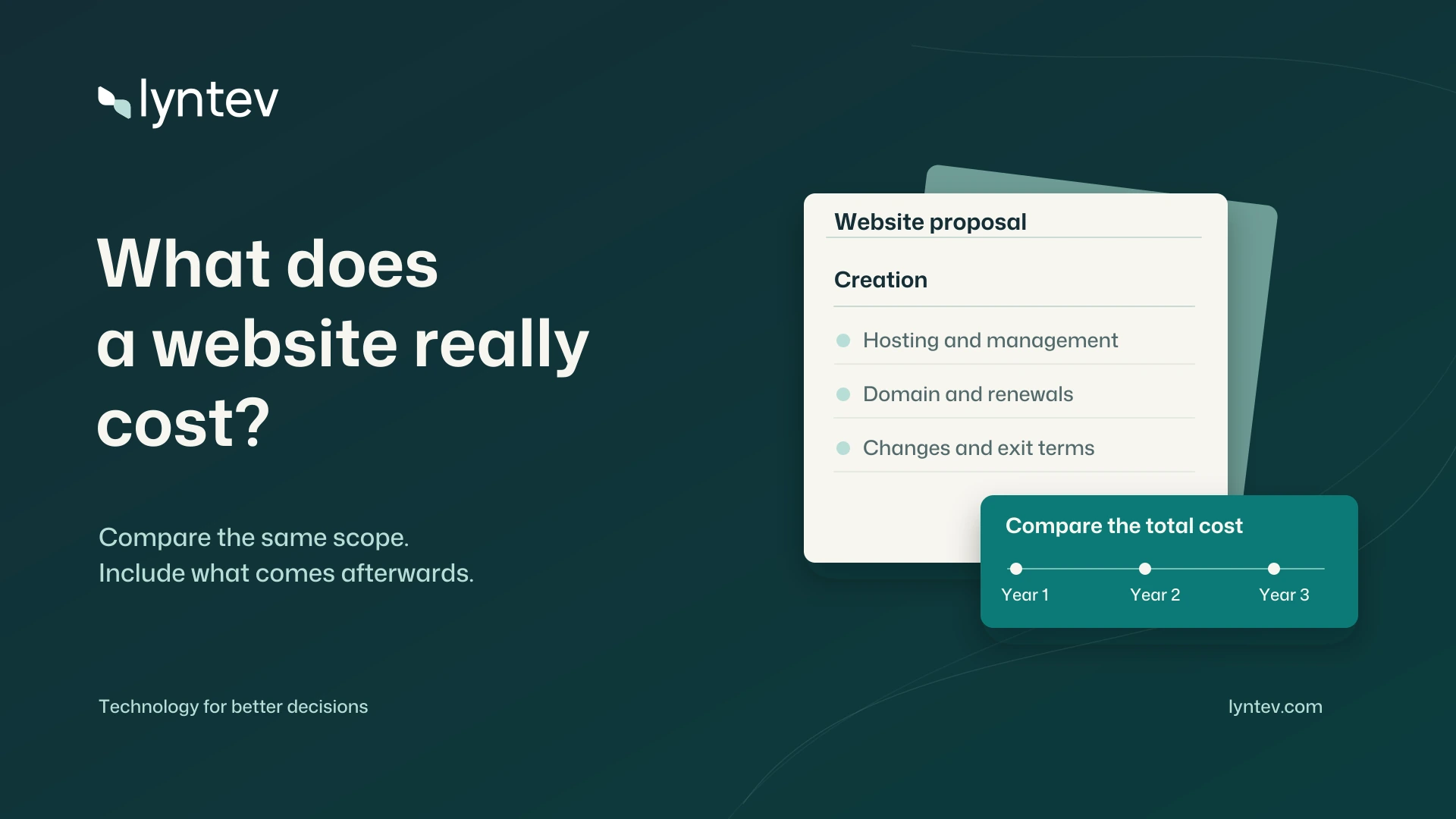
In this article:
- Compare proposals with the same scope.
- Calculate initial, recurring and exit costs.
- Request acceptance evidence and terms in writing.
Abstract
The advertised price of a website rarely describes, on its own, the full commitment needed to use it. This article proposes a comparison method that includes creation, operation, the domain name, content, external services, internal work and ending the service. The analysis combines technical documentation on cloud services, risk management, accessibility and domain registration with an arithmetic model of total cost. Two comparable fictional proposals are developed over a 36-month horizon, with explicit assumptions, alongside a sensitivity analysis for content changes. Documentary research is used to support the technical and contractual criteria; the example figures are solely educational and do not represent market prices or a Lyntev quote. The conclusion is that comparison should begin with functional equivalence and end with a demonstration of delivery, maintenance and portability. A low price may be appropriate for a simple scope, while a more extensive proposal should justify its value through verifiable needs, responsibilities and results.
Keywords: websites; total cost of use; software procurement; domain name; maintenance; commercial transparency.
1. Introduction
“Website for 150 €”, “website for a monthly fee” and “bespoke online shop” describe different commercial offerings. One proposal may include a business information page; another, a catalogue with ordering; another, payments and integrations. Comparing the headline figure in the advertisement is of little use if the client is actually comparing different work.
The first step is to define the intended operation. Presenting services and providing contact options requires one scope. Enabling purchases with payment, order management and delivery rules requires another. A visual shopping basket in a demo does not prove that a sales operation has been implemented. The proposal should describe the final behaviour and what will be tested before delivery.
This article organises comparison into three dimensions: what becomes functional, what it costs over the period and what happens when the client needs to make changes or end the service. The aim is to enable a documented decision that people who do not work in technology can understand.
2. Method and fundamental distinctions
A targeted documentary review was carried out, with sources consulted on 20 November 2026, using original sources from NIST, W3C, Google, Associação DNS.PT and the EDPB. The research focused on cloud services, portability, operational risk and rights associated with the domain name. No representative survey of agency prices was carried out. The figures below were constructed to demonstrate the method and do not support a conclusion that a price is above or below the market.
NIST SP 800-146 relates the economic opportunities of cloud services to control, network dependence, portability and service terms. It is a foundational reference published in 2012: its analytical framework is used here, rather than a description of current technologies or prices. The applicable principle is to compare responsibilities, limitations and continuity alongside price. (Badger et al., 2012)
Here, total cost of use means the sum of payments and internal work associated with the website over a defined horizon. The expression includes elements that do not always amount to ownership of the software: a licence may permit use without transferring the code. Rights of use, domain ownership, access to content and intellectual property should be addressed separately.
3. Making the scope comparable
Before collecting prices, draw up a list of tasks the website must fulfil. For each task, record the expected behaviour, evidence of acceptance and the person responsible. “Contact form”, for example, should mean actual submission, validation, a confirmation message and receipt at the destination, with a defined process for handling failures.
| Element | Useful specification | Evidence of acceptance |
|---|---|---|
| Content | Number of pages and sections, languages and materials | Approved final inventory |
| Contact | Channels, form and destination of requests | Test submission received |
| Shop | Products, variants, basket, payment and order | Complete journey in a test environment |
| Appointments | Resources, availability and confirmation | Valid attempt and conflicting attempt |
| Updates | Who changes what, quantity and agreed timeframe | Demonstration of the process |
| Delivery and ending the service | Files, access details, export and assistance | Documented package and procedure |
Table 1 note. Author’s own work. The scope should be proportionate to the project; a feature should only be listed if it is needed and contracted.
A template-based proposal may be appropriate if the design and structure meet the need. A bespoke project should justify the additional effort: custom navigation, a different process, extensive content or specific integrations. The word “personalised” should be made concrete. Changing colours and a logo, rearranging sections and developing an application are different levels of intervention.
It is also important to separate the contractual outcome from results that depend on third parties. The presence of titles, links and accessible content can be checked. A guaranteed position on Google is not a technical acceptance test. Google’s documentation distinguishes preparation for search from the ability to guarantee indexing or ranking. (Google, s.d.-a)
4. Components of total cost
4.1. Creation and launch
These include design, adaptation or development, content review, product imports, initial configuration and training. The proposal should identify who supplies photographs, text, translations and legal documents. Missing materials may affect the timeframe and add work. Included revisions and the procedure for changes to the scope should be defined.
4.2. Operation and external services
Hosting, domain names, business email, appointment tools, payments, SMS and extensions may have different providers and billing cycles. Some expenses depend on usage. The proposal should state who charges, whether the cost is fixed or variable and when approval is required. A first-year promotion should present the renewal terms relevant to the following period.
Domain registration should identify the holder and the entity that manages it. The .pt rules in force since 1 July 2026 govern registration, transfers, renewal and responsibilities. It is important to distinguish changing the managing entity from changing ownership. The client should know how to keep their details up to date and how to receive renewal notices. (Associação DNS.PT, 2026)
4.3. Maintenance and operational risk
Maintenance may mean hosting, updating components, checking links, keeping backups, resolving incidents or changing content. The generic term should be replaced by tasks and limits. NIST’s guide for small businesses includes access management, authentication, updates, backups and incident preparedness. For procurement, these recommendations translate into questions about who carries out each task and how recovery is demonstrated. (Eliot, 2024)
A contract may provide for technical support without a guaranteed response time. If the business needs a commitment to availability or recovery, it should request this explicitly and assess the cost. A phrase such as “support included” does not, on its own, clarify hours, channel, priority or the maximum duration of an interruption.
5. Calculation model and reproducible example
For a horizon of H months, the following accounting identity is proposed:
Equation 1. Total cost = creation + monthly fees + annual expenses + variable usage + changes + internal work + transition when ending the service.
Each component is counted only once. If the monthly fee already includes hosting, that amount is not added again as an external expense. Figures should use the same tax basis: total amounts payable or comparable net amounts, with the difference made explicit. The horizon should match the period the business wishes to assess, including minimum commitments and renewals.
Consider a business information page with an equivalent scope in two entirely fictional proposals. In option A, creation costs 150 € and technical operation costs 12 € per month. In option B, the first twelve monthly fees of 25 € cover creation and operation; after that, operation costs 12 € per month. Solely for this exercise, assume a domain name costing 18 € per year, provided free in the first year of option B. The remaining assumptions are in the table.
| Component over 36 months | Option A | Option B |
|---|---|---|
| Separate creation cost | 150 € | Included in the initial period |
| Monthly fees for months 1 to 12 | 144 € | 300 € |
| Monthly fees for months 13 to 36 | 288 € | 288 € |
| Domain name, under the assumptions | 54 € | 36 € |
| Three content changes at 40 € | 120 € | 120 € |
| Hypothetical transition when ending the service | 60 € | 60 € |
| Payment subtotal | 816 € | 804 € |
| Internal work: 2 hours at 15 € | 30 € | 30 € |
| Illustrative total cost | 846 € | 834 € |
Table 2 note. Author’s own work. All figures are educational assumptions and total amounts payable. They are not supplier quotes, verified domain prices or Lyntev offers. No inflation or financial discounting is applied. The options remain active throughout the 36 months.
The difference is 12 € over three years. Under these conditions, the decision should hardly depend on that difference alone. Included content, ease of making changes, reliability, access details and ending the service may be more relevant. If the business wishes to cancel before the end of the initial period, it will need to add the corresponding contractual terms to the comparison; the example does not assume them.
5.1. Sensitivity analysis
The most uncertain value may be the frequency of changes. Keeping the cost at 40 € per change, increasing from three to twelve interventions adds 360 € to both options. The totals become 1,206 € and 1,194 €, respectively. This exercise shows why it is important to estimate usage and check whether a suitable content maintenance option is available.
For a shop, the calculation should be repeated with the number of products, imports, photographs, payment fees, messages and order reconciliation. A percentage-based charge requires an assumption about sales volume. That assumption should be identified as a scenario, accompanied by alternative figures and kept separate from the business’s revenue forecast.
6. Quality and portability also need evidence
Price should be compared with observable quality requirements. A reference to WCAG 2.2 can guide accessibility criteria, but a claim of conformity requires an appropriate assessment. When accepting a small project, the main keyboard journey, field identification, readability and behaviour on mobile phones should at least be checked. This partial check does not amount to certification. (W3C, 2024)
Where personal data is involved, the roles of the client and provider should be defined. The EDPB’s guidelines on controllers and processors give weight to actual activities and specific obligations. For the contract, the practical question is who processes which data, with which providers, for how long and with what procedure for return or deletion. An export of website content may not include form records or data from an external tool. (CEPD, 2021)
When testing the process of ending the service, request an example export and a description of the migration steps. Check formats, attachments, images, content, the domain name and dependencies. The existence of a downloadable file does not demonstrate that another solution can import it in a usable form. Transition costs should include adaptation work, possible downtime and responsibilities.
7. Discussion and limitations
The model adds up known costs and scenarios, but does not turn uncertainty into precision. The website’s useful life, catalogue growth and frequency of changes may change. The cost of interruptions is particularly difficult to estimate and should not be filled in with an arbitrary number presented as fact. It can be addressed through clearly identified scenarios.
Technical references help formulate questions and criteria; they do not assess every provider or allow a universally fair price to be calculated. The illustrative proposal does not include online sales, integrations, photographic production or extensive writing. Adding these needs requires the scope and calculation to be redone. Comparison should also consider the client’s own ability to produce materials and keep the project running.
8. Conclusion
A transparent proposal makes it possible to understand what will be delivered, when payments are due, what operation costs and how to end the service. Decisions improve when the client compares equivalent tasks, uses a common horizon and separates fixed, variable and optional costs. A website’s commercial value should be supported by verifiable usefulness and quality, with terms that can be understood before entering into a contract.
Appendix A. Comparison sheet to request from each provider
- Delivery: pages, features, languages and acceptance criteria.
- Launch: materials to supply, payments, revisions and conditional timeframe.
- Operation: monthly fee, included tasks and usage limits.
- External expenses: provider, amount or formula, renewal and prior approval.
- Changes: included quantity and price or criteria for additional work.
- Continuity: ownership, access details, backups and demonstrated recovery.
- Ending the service: notice, outstanding commitments, export, assistance and cost.
Three ways to apply this analysis.
Compare ways to get started, the technical solution and what is worth preserving in an existing website.
Free or paid website: avoid discovering the limits too late
Test the essential task before paying or committing to an address for your business.
WordPress or a bespoke website: compare editing, operations and continuity
A decision about who publishes, what the website does and how it keeps working.
Refresh your website or build a new one: decide using evidence of what fails
Find what is worth keeping before commissioning a rebuild.
Editorial disclosure
Institutional authorship and editing: Lyntev. A narrative review and applied analysis, prepared with artificial intelligence support and not submitted for peer review. Frameworks and scenarios identified as our own do not constitute empirical research results.
Lyntev provides website and software services and has a commercial interest in these topics. The cited sources do not assess or recommend Lyntev or its products. The articles provide general assessment criteria; technical, legal or clinical decisions require consideration of the applicable context.
Sources consulted when preparing the edition of 20 November 2026. Have you found something that needs correcting? Contact Lyntev and identify the article and reference.
References
Associação DNS.PT (2026). Regras de registo de .pt. Em vigor desde 1 de julho de 2026.
Domain registration rulesBadger, M. L., Grance, T., Patt-Corner, R., & Voas, J. (2012). Cloud computing synopsis and recommendations. NIST Special Publication 800-146.
Technical frameworkComité Europeu para a Proteção de Dados [CEPD] (2021). Guidelines 07/2020 on the concepts of controller and processor in the GDPR. Versão final, 7 de julho de 2021.
Regulatory guidanceEliot, D. (2024). NIST Cybersecurity Framework 2.0: Small business quick-start guide. NIST Special Publication 1300.
Technical frameworkGoogle (s.d.-a). Search engine optimization (SEO) starter guide. Google Search Central.
Technical documentationWorld Wide Web Consortium [W3C] (2024). Web Content Accessibility Guidelines (WCAG) 2.2. W3C Recommendation, edição de 12 de dezembro de 2024.
Technical standard
From analysis to application.
Continue the series.
All research articles- Digital presenceI'm on Instagram. Do I also need a website?
- Artificial intelligenceAI in customer service: what studies show and how to evaluate it in your business
- Salon managementHow to choose business management software for a beauty salon
- Clinic managementSoftware for clinics: what to test before signing a contract
- Experience and measurementYour website gets visits. Why aren't you receiving enquiries?